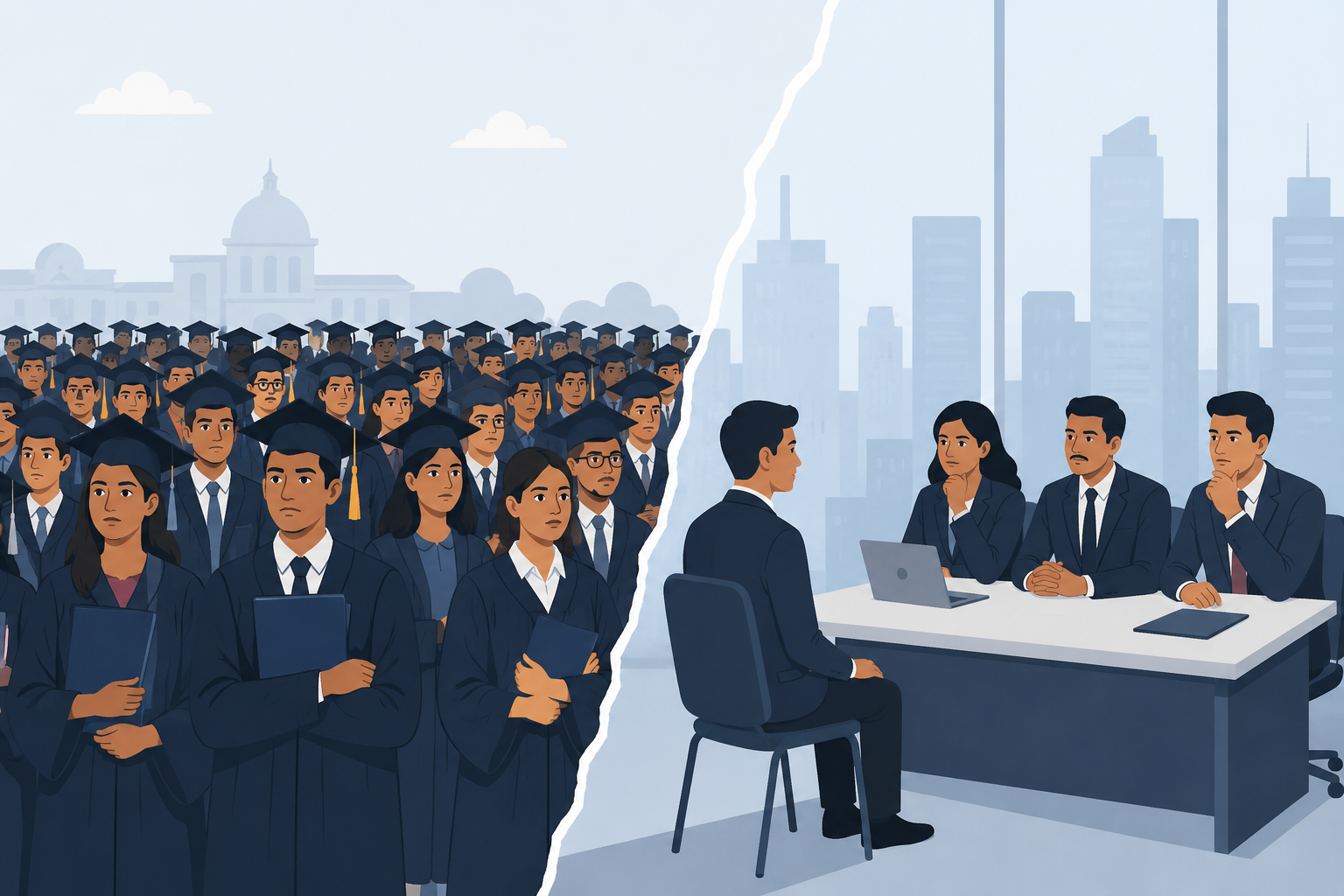
Every year, India adds one of the largest pools of graduates to the global workforce. Engineering colleges, universities and technical institutions collectively produce millions of graduates across disciplines.
Yet employers across industries continue to report the same challenge.
Finding job-ready talent remains surprisingly difficult.
At first glance, this appears contradictory. If supply is abundant, why is hiring still so challenging?
The answer lies in understanding the difference between education and employability.
Quantity Has Never Been India’s Problem
India’s higher education system has expanded rapidly over the past two decades.
More institutions, more students and more graduates should logically create a stronger talent pipeline.
However, hiring managers consistently point towards another issue.
Many graduates possess theoretical knowledge but struggle to apply it in practical business environments.
According to Times of India and a study conducted by Acciojob, only 43-45% of graduates are considered immediately employable for technology roles in India.
This doesn’t suggest a lack of intelligence.
It suggests a gap between what is taught and what employers actually need.
The Cricket Analogy
Imagine a cricket academy.
Students spend four years studying batting techniques.
They memorise field placements.
They understand swing, seam movement and batting strategy.
But throughout those four years, they rarely face a real fast bowler.
On paper, they know cricket.
In reality, their first competitive match becomes their first practical lesson.
That is remarkably similar to the challenge many graduates face.
Knowing concepts and applying concepts are two very different skills.
The Industry Is Moving Faster Than Classrooms
Technology evolves rapidly.
Programming frameworks change.
Cloud platforms evolve.
AI tools have become mainstream.
Data engineering workflows mature.
Unfortunately, university curricula often take years to reflect these changes.
By the time many students graduate, the technologies they studied may no longer represent what companies use daily.
This isn’t necessarily a failure of universities. Academic systems naturally prioritise stability, while technology companies prioritise speed.
The result is an unavoidable gap.
AI Has Accelerated the Challenge
Artificial Intelligence has increased employer expectations.
Tasks that previously required junior developers can now be partially automated.
This means entry-level professionals are expected to contribute more quickly than before.
Employers increasingly value candidates who can:
- Build projects independently.
- Collaborate with AI tools.
- Solve unfamiliar problems.
- Explain technical decisions.
- Work across multiple technologies.
The focus has shifted from “What language do you know?” to “What can you actually build?”
Why Projects Matter More Than Certificates
Certificates demonstrate participation.
Projects demonstrate capability.
A GitHub repository.
A deployed application.
A dashboard analysing real data.
An AI-powered chatbot.
These provide tangible evidence of learning.
Recruiters often prefer reviewing practical work because it reflects how candidates think, structure problems and solve challenges.
It’s similar to hiring an architect.
A degree matters.
But seeing buildings they’ve designed matters even more.
Bridging the Gap
Fortunately, the employability gap is not permanent.
Many students now supplement traditional education with practical learning experiences that focus on real projects, mentorship and interview preparation.
This is where industry-led training platforms have become increasingly important. Instead of replacing university education, they complement it by helping learners apply theoretical knowledge to practical business problems. Whether students pursue software development, data analytics or AI, structured project-based programmes can significantly improve job readiness when combined with academic foundations.
The Road Ahead
India does not have a shortage of ambition.
It does not have a shortage of graduates.
What it faces is a translation challenge.
How do we convert classroom knowledge into workplace capability?
The answer is unlikely to come from replacing traditional education altogether.
Instead, it lies in building stronger connections between academia and industry, encouraging project-based learning, embracing modern technologies and helping students develop skills that employers genuinely value.
As AI transforms the workplace, this conversation becomes even more important.
The graduates who succeed won’t necessarily be those with the longest list of certifications.
They’ll be the ones who can demonstrate that they know how to solve problems, adapt quickly and keep learning long after graduation.